CentralNest replaces the routine in-person survey with an async video walkthrough. No call, no scheduling, no second person required for the moves that don't need one. Competitors moved the surveyor onto a video call instead, for every job. We think that's a stopgap, not the answer.
This isn't an argument against surveyors. Some moves genuinely need someone on-site: an elderly customer who wants a familiar face, a business relocation, a high-value or complex property. What we're against is spending a surveyor's morning on a routine three-bed semi that the customer could film themselves in ten minutes. Take the admin off the surveyor's plate, and free up their time for the visits that need them.
Three ways to survey a move
A surveyor visit needs two diaries to line up. Most software built after 2020 moved that same visit onto a video call, same two people, same live appointment, just over Zoom instead of the hallway. It saves the drive. It doesn't save the diary problem. CentralNest skips the appointment altogether: the customer films their own home whenever it suits them, and the AI builds the inventory from the footage.
Surveyor and customer, in person. Right call for a complex or high-value move, but a booked visit and a wasted trip if anyone cancels.
Surveyor and customer, on a call. Same appointment, same clash risk, just remote instead of in the hallway.
Customer, on their own. Recorded whenever they get to it. Nothing to reschedule, because nothing was booked.
Three ways to get the video, no calls involved
We don't force one workflow on every customer. There are three routes into the same async process, and none of them involve a live call.
Customer-led. The customer records the walkthrough themselves on their phone, at whatever hour suits them. This is the default, and the one most people choose given the option.
Collaborative. The customer records the video, then the removal company reviews it and follows up async, by message or a note on the quote, rather than a scheduled call.
Surveyor-driven. For trickier jobs, the company's own surveyor records the walkthrough on-site. Still no call. The footage goes through the same AI pipeline as everything else.
Why we built it this way
Speed. A video call still needs a slot in two calendars. A self-recorded walkthrough needs a slot in one, the customer's, and they can do it at 11pm in their pyjamas if that's when they get round to it. Quotes come back in minutes, not days.
Consistency. A person doing a video call gets tired, distracted, or rushed on a Friday afternoon. The AI checks every room, every item, every access point, the same way, every time. Fewer items get missed. Fewer quotes get revised on moving day.
Respect for the customer's time. Booking a call means someone has to clear 30 to 45 minutes, wait for the surveyor to join, and stay put for the whole thing. A self-recorded walkthrough takes a few minutes and fits around a life that isn't built around your booking calendar.
Other industries have had this argument too
Banking had the same fork in the road. Some high street banks added video tellers: a real person, on a screen, at a set time. The neobanks, Monzo and Starling among them, skipped the teller for most everyday banking: identity checks, statements, support, all handled async, in the app, on the customer's schedule.
It isn't a clean win either way. When something goes wrong, people still want a human to call, which is exactly why we don't force self-service on every job either. Most moves don't need a live appointment. The ones that do, an elderly customer, a business relocation, a complex property, still get a person, not a video call as a substitute.
The number that convinced us
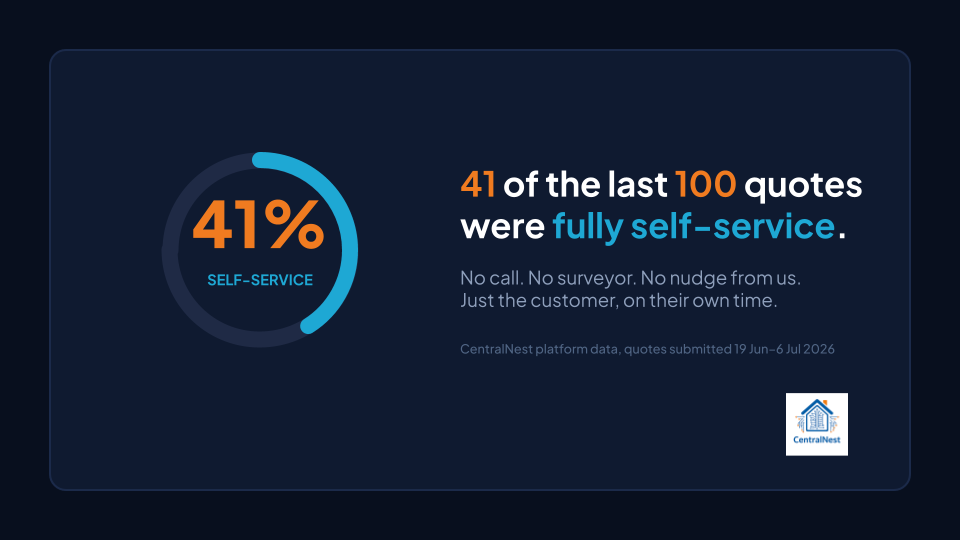
We didn't design around a theory. We checked our own data. Across the last 100 quotes on our platform, 41 were completed entirely self-service: no call, no surveyor, no nudge from us. Given the choice, roughly four in ten customers just get on and do it themselves.
For jobs that don't need a visit, customers aren't waiting for a friendlier version of the call. Given the choice, plenty would rather do it themselves, and that frees up the surveyor's day for the moves that do need a person in the room.
See it for yourself
Quotes back in minutes, not days, with no call to schedule on either end.